
Bill Gallegos, Liberation Road
September 22, 2019
This article is based on my presentation given at a Solidarity with the People of México event on September 22nd in Los Ángeles. In several respects this presentation is a critique of the US left, including the socialist left, that has ignored the importance of the 1848 annexation of México’s northern territories. This failure to analyze the significance of annexation for US economic and political development, the under-development of México, and the evolution of an oppressed Chican@ Nation within US borders remains a strategic weakness of our movement. Most organizations in the US left, including communist and “new communist organizations” paid little or no theoretical attention to these matters, or - in the case of Chican@s and Mexican@s in the US - narrowed the question primarily to an immigrant rights issue, or an even more narrowly-defined labor issue. Current events in México and at the US border have forced the question onto the political landscape, and yet the left has been largely unable to offer leadership or a coherent response to both the Trump Administration’s ethnic cleansing campaign, or to the new progressive political developments in México with the election of Andrés Manuel López Obrador and the Morena Party.
This new piece from Liberation Road is our latest contributionto the US left and progressive movements in our organization’s efforts todefine a strategy toward achieving socialism. It is connected to earliercontributions from our predecessor organizations: Fan the Flames, The Struggle for ChicanoLiberation, and The SunbeltStrategy and Chicano Liberation. It highlights the importanceof our struggle to dismantle US imperialism and support the struggle of thenearly 40 million Chican@s in the US; to grasp the strategic importance oflinking that struggle with left and progressive social movements in México; andto deepen our Sunbelt Strategy analysis of several years ago. This strategy isrooted among not only the Chican@-Mexican@ people in the Southwestern US, butwith the more than 25 million African Americans in the US South. The Sunbelt isalso home to the largest Indigenous populations within US borders, as well asthe largest concentrations of Asian Pacific Islanders, and large concentrationsof white workers.
Foundational to thishistory are the original peoples that populated the hemisphere thousands of yearsbefore 1492, before the origins of a Mexican state, before the US annexation ofNorthern México. Resisting the hundreds of years of extermination campaigns bySpain, by México, by the United States of America that decimated theirpopulations, native peoples have always fought back. Their long memories andknowledge of their ancestors’ histories are the foundation of their traditionof resistance, and of their dignity.
Unless we understand and focus on the strategic significance ofthe interlocking histories and connections between the peoples in thegeographic areas that were once Mexican and now are part of the US, we will notwin.
BG

US Expropriation of Mexican land, 1845 -1848
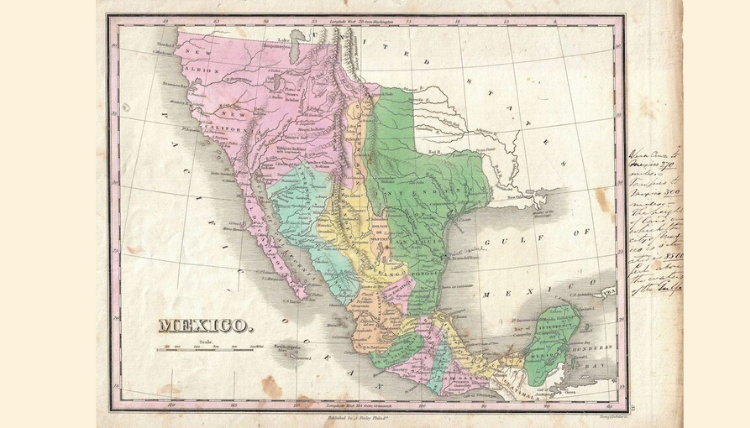
There is an important series of events in U.S. history that receives very little attention as to its tremendous historical and contemporary significance: the annexation of México’s northern territories by the United States, beginning with the Mexican state of Texas in 1845, and virtually half of México after a short, unjust and inglorious war, ratified in the 1848 Treaty of Guadalupe Hidalgo. These territories include the states of Nuevo México, Nevada, Arizona, California, Texas, Utah, and western Colorado.

These historicalevents represent the third foundational phase in the construction of a whitesupremacist imperialist superpower, which would, within a century afterannexation, dominate the world. Thefirst phase was the genocide of Native peoples and the seizure of their landsand resources, clearing the way for European settlement. The second was theimportation and exploitation of Africans as slavelabor to kick-start the US capitalist economy. And the third phase that laidthe basis for eventual US global hegemony was the defeat of México in theMexican-American War of 1846 - 1848 and the subjugation of Mexicans in theSouthwestern United States.
The annexation of México’s northern lands, largely through military aggression (labeled by Ulysses S. Grant as “imperialist” and opposed by then Congressman Abraham Lincoln) had three major outcomes:
- It enabled the United States of America tobecome the dominant capitalist superpower in the world.
- The United States spread its reach from the Atlantic coast to the Pacific coast, as it proclaimed was its God-given right (Manifest Destiny), thereby allowing for a vast expansion of the Anglo population as primarily settler colonists of the newly-acquired territories. The US war against México was motivated primarily by the Southern US slaveocracy, which hungrily sought new territories for its plantation economy and the lucrative slave trade.
- If México’s northern territories not been seized, the United States might well have become a second or third-rate power like Spain or France, but hardly the super-power of today. Through this annexation, the United States acquired some of the most fertile agricultural lands in the world, lands also rich in oil, coal, uranium, gold, silver, copper and other mineral deposits.
- Profoundly important for its ascension to a global powerhouse, the USA acquired maritime access to trade and resource extraction along the entire Pacific Rim. Otherwise, it would not have controlled ports on the Pacific.
2. It subordinatedMéxico to US interests
- Beforethe US war of aggression against México, the two nations were roughly co-equalin size. México owned the gateways tothe Pacific, and the rich natural resources necessary for capitalistdevelopment.
- Duelargely to the loss of its northern territories, México effectively became aneo-colony of the US, a dependent nation of the Global South. The signing ofthe Treaty of Guadalupe Hidalgo in 1848 ratified this historic theft. Méxiconow was confronted with a nearly 2000-mile imposed border with a militarilysuperior power. The movement of peoplefrom one side to the other became restricted.
- Beforethe war with the US, México had won its independence from Spain only 25 yearsprior, in 1821. Its first black president (ours not until 2008!) VicenteGuerrero abolished slavery in 1829. While México has had its own internalstruggles and may have had conservative politics dominate even without USinterference, it certainly would have been a more sovereign nation less proneto US meddling.

3. The Annexation ofMéxico’s northern territories led to the evolution of a new oppressednationality: the Chican@/Mexican@ people.
- The Chican@/Mexican@ people have evolvedas a distinct and oppressed nationality, separated for generations from theirhomeland (although family ties have always been maintained). Thewhite-supremacist capitalist class prevented them from assimilating as equalswith the dominant European majority and thereby from enjoying the rights andfreedoms accorded to whites.
- Following annexation, the United Statesconsolidated its conquest through a policy of terrorism, bribery, and trickery.While the Treaty of Guadalupe Hidalgo promised that existing landowners in whatbecame US territories would not lose ownership of their land, those promiseswere not kept. Mexicans were stripped of their assets: 525,000 square miles(1,359,744 square kilometers) of land were taken through force, murder,trickery. The lack of assets and basic rights created a subordinate racializedgroup whose main option was to become a cheap labor force for the newwhite-owned agricultural enterprises.
- Ensuing laws and practices institutionalizedinequalities for the Chican@ people. These included the denial of theirlanguage and culture, residential segregation, inferior public education (likeAfrican Americans, they also had to sue to gain admission to white-onlyschools), racist credit and banking systems, police and state repression,denial of voting rights, job discrimination, and so on. Today, these basicstructures remain in place and maintain inequality for Chican@s in all realmsof US economic, political, cultural, and social life.
- Because of the early abolition of slavery inMéxico and the right of Mexican women to own land, something not allowed in theUS at that time, blacks and women also lost rights due to annexation andsuffered greater oppression than they would have in México.

90% of the 37 million Chican@ population in the US reside inthe historic pre-annexation areas: Texas, California, Arizona,Nuevo México, and Colorado. Over the last several decades they have been joinedby significant numbers of immigrants and refugees from Central America, whooften live in the same neighborhoods, send their children to the same publicschools, work in many of the same low-wage jobs, and suffer from the samestructures of oppression as their Chican@ sisters and brothers. These geographic areas of historic Chican@concentration are the Chican@ homeland, la patria, la nación. With our blood,sweat, and tears, Chican@ labor has built much of this area’s economy, itsagricultural system, its transportation, energy, and manufacturinginfrastructures.
But oppression breeds resistance! Chican@ resistance iscomprehensive and ubiquitous: union organizing and strikes, armed struggle,broad and diverse cultural forms (Spanish language press, media, art, music,teatro, etc.), legal challenges, grassroots fights for economic and educationalinclusion, for immigrant rights, and for environmental and gender justice. Today, resistance has also taken the form ofelectoral organizing.
As a result, Chican@s have become a major force in theelectoral arena. On the one hand theyare wooed by politicians. But on theother, the ruling class has stepped up efforts to restrict our vote throughgerrymandering and voter suppression laws, especially in states like Texas andArizona where we are fast becoming a majority. The backlash is worse than that: the racist right-wing, sometimesreferred to as the New Confederacy, has, under Donald Trump, unleashed anethnic cleansing campaign against our people, a campaign that has incarceratedhundreds of thousands, includes the imprisonment and death of children, massivefamily separation, growing rates of deportation. These measures have fomented apervasive atmosphere of fear in Chican@ barrios - and have sparked organizingefforts in defense of our brothers and sisters.
The ferocity of the attacks serves to prove that Chican@spose an existential threat to the US empire. We are not only a young, growing and dynamic population, but areconnected by a thousand ties - historical, familial, cultural, economic,ideological - to the dynamic and growing social movements in México. All thismakes more clearly evident the necessity to unify the Chican@ movement and toraise once again our program for national rights to land, self-government, andcontrol of our economy. The long historyof US interference in México and its oppression of Mexican@s/Chican@s in the USmakes clear the strategic importance of building solidarity with the people ofMéxico whose fates have been connected to those on the Northern side of theborder. Together, we can be a mighty force.
Solidaritywith the people of México is a central element of our internationalist strategyto build unity among all oppressed and working peoples of the US andbeyond. Imposed borders, artificial lines in the sand, cannot stopus. We can build opposition to US interference in México, open spacefor México to exercise its sovereignty, and remove barriers between peopleswith the same historical roots. In our striving to end imperialism, workingpeople can construct societies that are just, egalitarian, peaceful, andgenuinely democratic, inwhich no nationality or gender is privileged, that live in close connection andharmony with Mother Earth, and most especially that are Sin Fronteras.
¡Si Se Puede!
This article can be downloaded as a pdf below